


Rooted Resilience: Integrating Native Desert Plants and IoT-Enabled Microclimates in Urban UAE Landscapes
Introduction
UAE cities face the dual challenge of environmental stress and resource scarcity in their urban landscape systems. Integrating native desert plants with IoT-based climate control infrastructure presents a compelling opportunity to enhance sustainability and functionality. Unlike ornamental exotics, native flora thrives under extreme heat, salinity, and limited water availability—all while requiring fewer maintenance inputs. When guided by real-time environmental data through IoT platforms, these plants contribute to a more intelligent, adaptive, and resource-efficient green urban fabric.
This article offers insight for landscape architects, urban planners, and sustainability professionals seeking to explore performance-based planting strategies in urban design. It highlights how native species, and technology can work together to deliver landscape solutions that align with the UAE’s ecological realities and smart city ambitions.
The Value Proposition of Native Plants in Urban Spaces
Native UAE plants are increasingly being recognized as viable and high-performance options in urban development projects. Their benefits extend far beyond survival—they support multiple environmental and operational goals:
- Reduced Water Demand: Evapotranspiration coefficients (Kc) under 0.4 enable 40–70% irrigation savings compared to exotics.
- Salinity and Heat Tolerance: Suitable for treated sewage effluent (TSE) irrigation and peak temperatures beyond 44°C.
- Stabilization Capabilities: Deep or fibrous roots stabilize soils, slopes, and protect against wind erosion.
- Biodiversity and Ecology: Provide forage, nesting, and shelter for native fauna while resisting invasive encroachment.
These species offer scalable design flexibility, functioning as groundcovers, architectural shrubs, hedging, and erosion-control matrices in a variety of urban forms—from civic streetscapes to rooftop gardens.

UAE-Native-Desert-Plants
Enabling Smarter Landscapes with IoT Technology
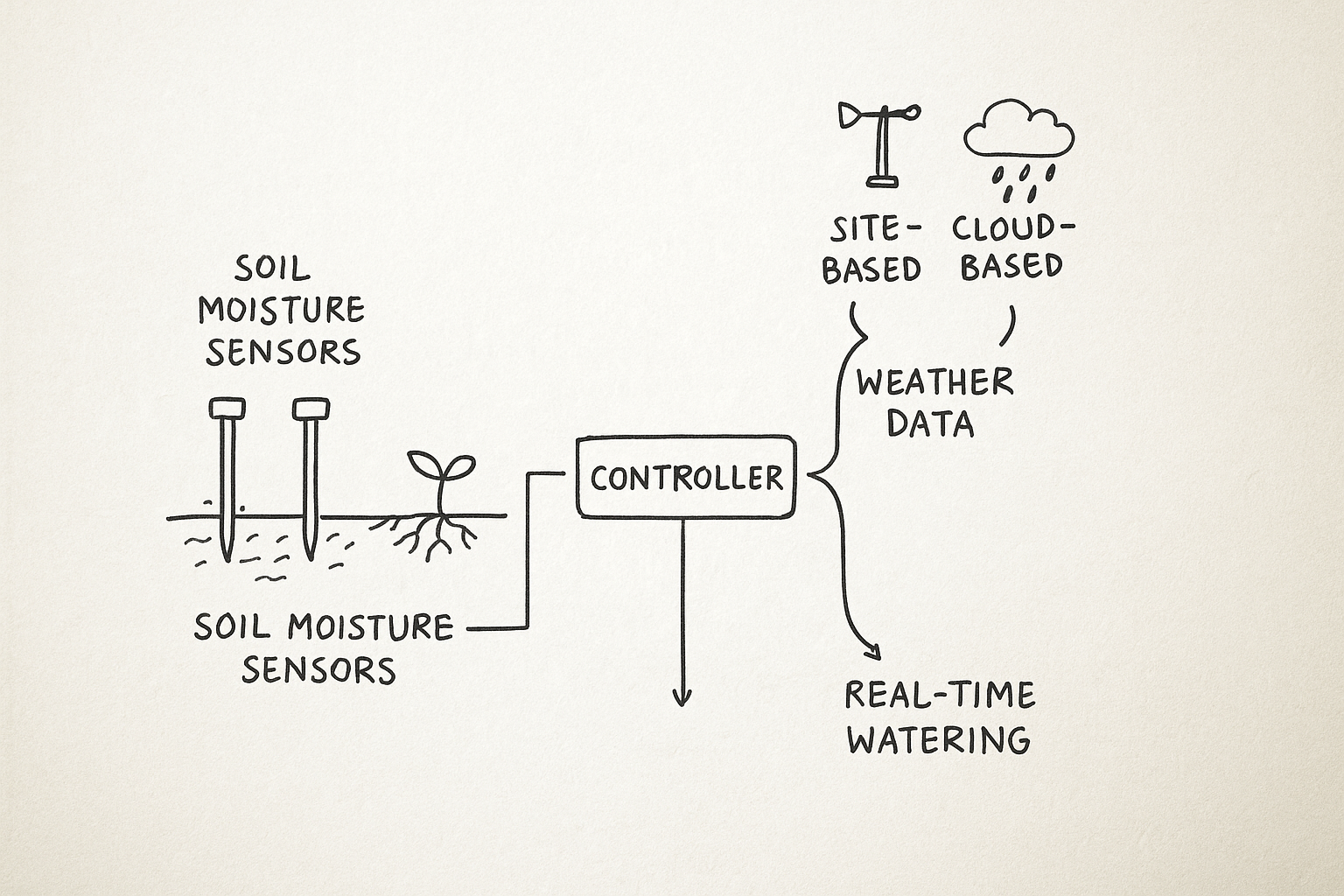
A critical starting point in any IoT-enabled urban landscape is understanding how soil moisture and microclimate data influence irrigation decisions. Soil moisture sensors—typically capacitive or tensiometric—measure the volumetric water content (VWC) of the root zone. Real-time data from these sensors ensures that irrigation is only activated when the soil moisture drops below specific thresholds (usually 12–14% VWC for native desert plants), preventing both over-irrigation and drought stress.
Complementing these are site-based or cloud-linked weather stations. On-site weather stations monitor hyperlocal variables—wind speed, temperature, humidity, and solar radiation—that directly impact evapotranspiration (ET₀) rates. Cloud-based weather APIs, while broader in scope, serve as secondary reference sources or for projects without physical instrumentation. Combined, they support predictive irrigation algorithms and dynamic scheduling models that adjust to climatic conditions in real time.
Determining the number of sensors for a project site depends on several technical factors:
- Zoning: Each irrigation control zone should ideally have one dedicated sensor, especially if plant species or sun exposure differs.
- Soil Variation: Sites with heterogeneous soils or grading (e.g., mounds and depressions) require more sensors to account for uneven water retention.
- Coverage Ratio: A baseline standard is 1 sensor per 200–400 m² for surface planting, with higher density recommended in rooftop or slope applications.
- Communication Protocol: Sensors using LoRaWAN or NB-IoT can support wide coverage (up to 2–5 km), minimizing gateway requirements.
Collected data is transmitted to cloud-based dashboards where it is processed alongside weather inputs and irrigation presets. This system then issues real-time commands to valves or pump controllers, completing a closed-loop, feedback-driven irrigation process that ensures every drop counts.
Smart landscaping is no longer a concept—it’s a technical advantage. IoT platforms enhance the viability of native-based landscapes by introducing adaptive control, real-time monitoring, and predictive maintenance. This approach enables stakeholders to balance ecological performance with operational efficiency.
Core Benefits of IoT Integration:
- Sensor-Triggered Irrigation: Prevents water waste and responds to actual root zone conditions.
- ET₀-Based Scheduling: Adjusts watering frequency based on evaporative stress indicators.
- Cloud-Based Management: Enables oversight of remote or large-scale projects via dashboards.
- Plant Health Diagnostics: Uses vegetation indices (NDVI) and thermal imagery for early stress detection.
IoT Element Functionality Applied Benefit
- Soil Moisture Sensor VWC-triggered irrigation Maintains optimal root zone moisture (12–14%)
- Environmental Node Tracks RH, temperature, wind, solar radiation Supports dynamic ET₀-based irrigation logic
- Flow Meters Monitors L/h per zone Detects leakage or inefficiencies immediately
- Imaging Tools NDVI/thermal scans Enables preventive plant stress response
Landscape Scenarios for Urban Applications
1. Rooftops and Podiums
• Plant Selection: Zygophyllum qatarense, Tribulus terrestris
• Design Function: Lightweight greenery with minimal irrigation demand.
• Tech Application: Temp and moisture sensors optimize limited root zone hydration.
2. Road Medians and Buffers
• Plant Selection: Haloxylon salicornicum, Calligonum comosum
• Design Function: Reduce heat reflection and maintenance costs in saline zones.
• Tech Application: EC sensors adjust irrigation for salinity loads.
3. Bioswales and Drainage Corridors
• Plant Selection: Stipagrostis spp., Zygophyllum qatarense
• Design Function: Improve infiltration and slow runoff.
• Tech Application: Rain sensors delay irrigation cycles post-storm.
4. Cooling Corridors
• Plant Selection: Haloxylon and Tribulus in staggered groupings
• Design Function: Reduce pedestrian zone surface temps by 3–4°C.
• Tech Application: Solar radiation sensors align irrigation with heat peaks.
Concluding Perspective
Urban landscapes in the UAE are under growing scrutiny for resource intensity, ecological fit, and climate resilience. Native desert flora, enhanced with real-time environmental control through IoT systems, presents a practical, scalable, and data-validated model for future urban greening.
>For practitioners, the value lies not just in sustainability rhetoric, but in quantifiable results: 48% less water, >70% survival in peak summers, and measurable heat mitigation. These outcomes shift the narrative—from ornamental greening to strategic ecological infrastructure.
By embracing native planting and IoT integration, urban spaces in the Gulf can achieve functionality, efficiency, and beauty—rooted in desert intelligence and powered by smart technology.
