


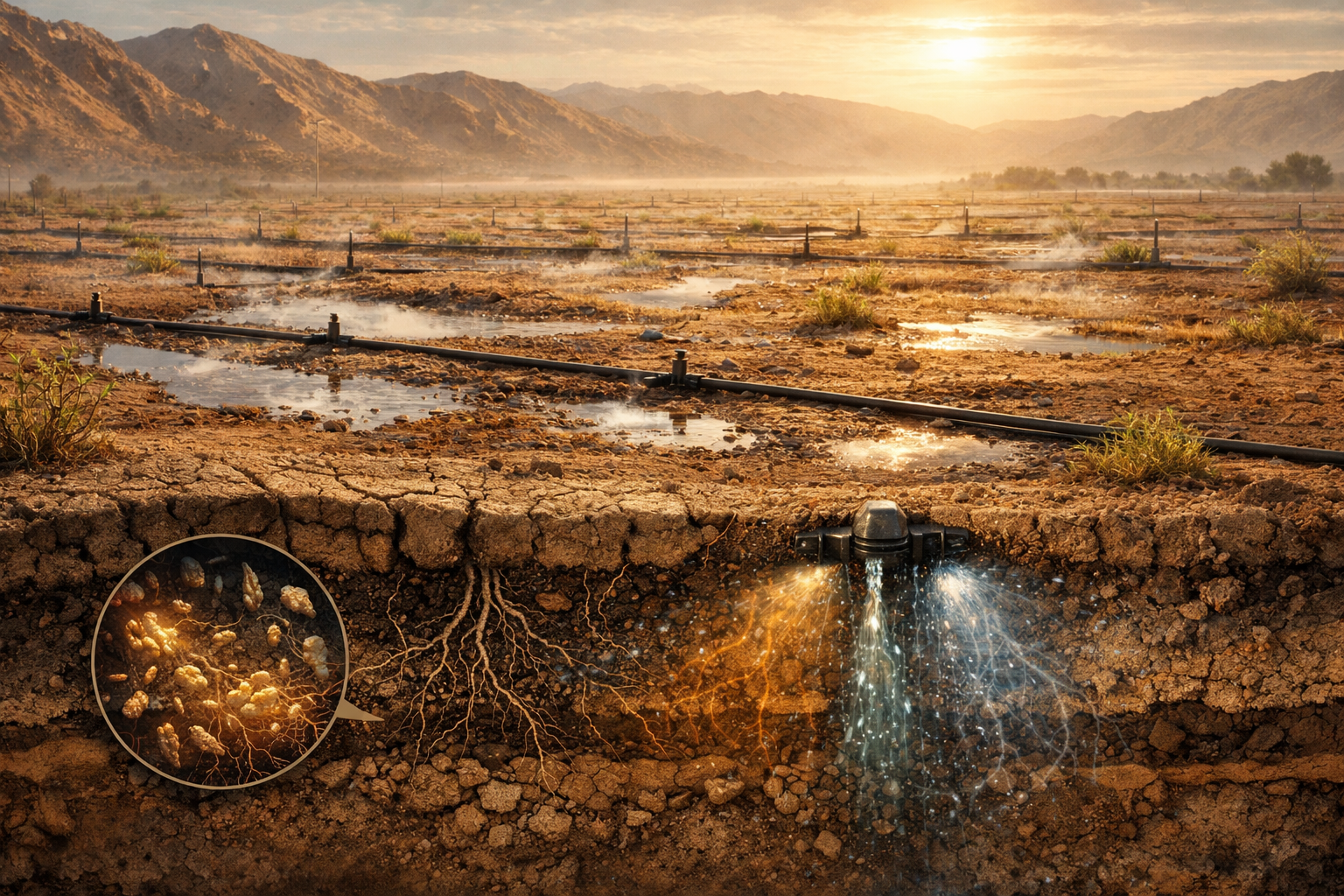
Field Observations on Native Vegetation, Soil Microbiology & Irrigation Behaviour in Arid Climate
Natural vegetation observed in desert regions of the UAE shows behaviour very similar to native planting conditions in KSA. Unlike irrigated landscapes, these plant clusters survive under extreme heat, sandy soil, and very low moisture, yet maintain stable growth due to deep root systems, active soil biology, and naturally balanced micro-climate. Such field conditions provide important technical insight into how irrigation demand, soil health, and plant stability are interrelated, and why excessive irrigation in designed landscapes often leads to plant stress instead of improvement.
1. Native desert plants and reduced irrigation demand
Field observations from arid regions show that species such as Prosopis cineraria (Khejri), Salvadora persica, Calligonum polygonoides, Artemisia spp., and seasonal desert herbs survive with minimal moisture due to deep root systems and low transpiration rate. As plant age increases, effective root depth increases, resulting in lower irrigation demand, consistent with FAO-56 evapotranspiration relation (ET_c = K_c X ET_o), where native woody plants typically operate at lower Kc values than turf or ornamental planting.
2. Micro-climate formation within plant clusters
Dense clusters of native shrubs and trees create localized shading, reduce wind speed near soil surface, and lower ground temperature. This micro-climate reduces evapotranspiration and slows moisture loss from root zone. Compared to exposed landscaped areas, clustered natural vegetation maintains higher soil stability with significantly less water input.
3. Active soil microbiology in undisturbed desert soil
Natural soil under native vegetation shows presence of worms, insects, and organic decomposition, indicating aerobic condition and active microbial population. Soil biology improves aggregation, increases moisture holding capacity, and supports nutrient cycling. References in soil science literature confirm that healthy root growth requires both moisture and adequate air-filled porosity in soil.
4. Effect of excessive irrigation on root-zone environment
In many irrigated landscapes, continuous high-volume watering leads to soil saturation beyond field capacity. When air-filled porosity falls below critical level, oxygen diffusion decreases and anaerobic conditions develop. Under such conditions, methanogenic and anaerobic bacteria produce methane and other reduced gases, which damage roots and reduce plant vigor despite sufficient water supply.
5. Algae growth and compaction as indicators of over-irrigation
Surface algae, wet soil crust, and shallow root growth are commonly observed in landscapes irrigated with long run cycles or uncontrolled discharge. These conditions indicate excess surface moisture, poor aeration, and imbalance in soil microbiological activity.
6. Relationship between soil moisture and biological activity
Soil physics studies indicate that optimum plant growth occurs when soil moisture remains around 50–70% of field capacity, where both water availability and oxygen supply are sufficient. Irrigation above this range reduces microbial activity and increases risk of root disease, especially in sandy or imported sweet soil used in GCC landscapes.
7. Native plant typology and irrigation coefficient
Desert-adapted species have lower transpiration coefficient and deeper moisture extraction depth compared to turf and ornamental planting. Field comparison shows that once established, native shrubs and trees can sustain with significantly lower irrigation frequency, provided soil aeration and micro-climate remain stable.
8. Root-zone temperature and soil depth effect
In exposed landscapes with shallow soil, surface temperature can exceed safe limits for root activity. Natural vegetation with deeper soil profile and organic cover maintains lower root-zone temperature, reducing moisture loss and improving plant survival.
9. Precision irrigation required to maintain aerobic soil condition
Metered irrigation, pressure regulation, hydro-zoning, and short controlled cycles help maintain soil moisture near field capacity without saturation. Such systems support microbial activity, prevent salinity build-up, and maintain stable root environment in arid climates.
10. Engineering conclusion for arid landscape development
Field observations confirm that sustainable greenery in desert environments depends on maintaining a balanced micro-climate, active soil biology, and aerobic root zone. Irrigation design should therefore focus on controlled and metered water application, proper zoning, and soil health management rather than increasing irrigation quantity alone.
Visit Website: evergreenadcon
